

Senka Perfect Whip Guide: Which Cleanser Is Right for You
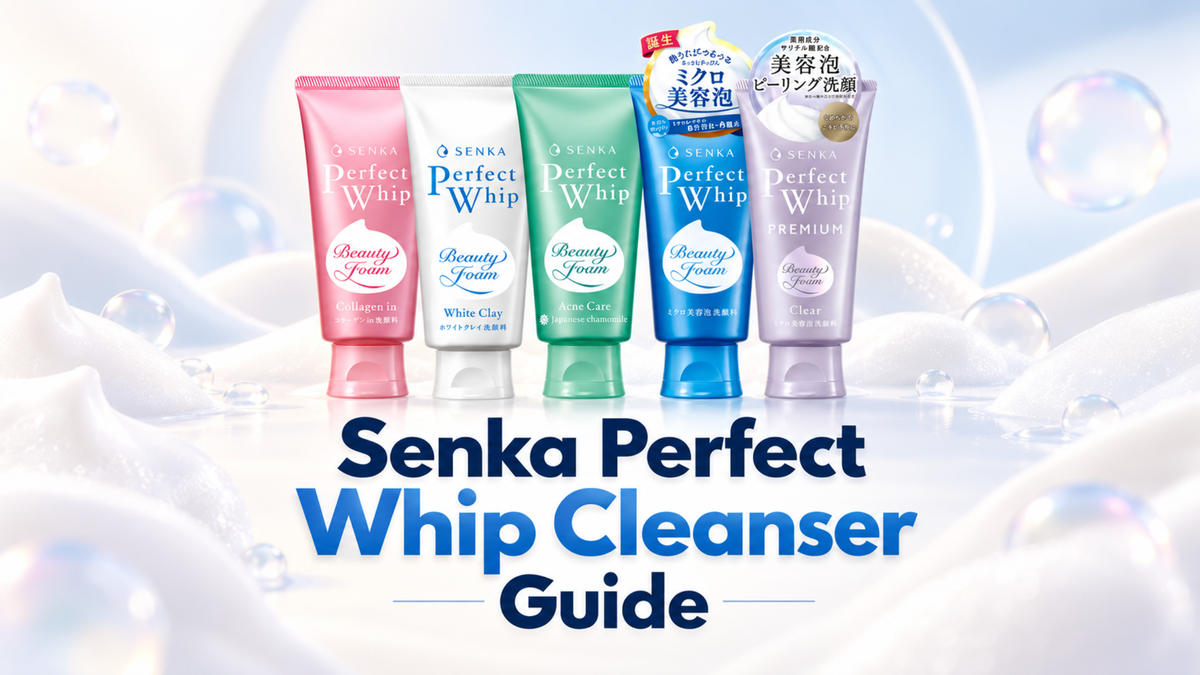
Senka Perfect Whip Guide: Which Cleanser Is Right for You
If you have spent any time in Japanese skincare, you have seen the tube. Senka Perfect Whip is one of those products that shows up in every drugstore haul, every Japan travel video, and every beginner routine list. It is cheap, it is everywhere, and the foam is genuinely famous.
The confusing part is that there is not one Perfect Whip. There are several, they look almost identical on the shelf, and the packaging is mostly in Japanese.
This guide breaks down the five we carry.
In This Guide
What Is Senka Perfect Whip? Japan's Best-Selling Face Wash Explained
Senka launched in 2003 as an affordable everyday skincare line, and Perfect Whip was its first hit. It has held the top spot in Japan's face wash category for years, which in a market that competitive is not a small thing.
The thing Perfect Whip is actually known for is the foam. Japanese shoppers judge a cleanser on lather quality as much as cleansing power, and this one produces a dense, cushiony foam from a very small amount of product. The idea is that the foam does the work, so you are not dragging your fingers across your face.
Good to know: Perfect Whip is a water-based foaming cleanser, which in a Japanese routine is the second step. If you wear makeup or sunscreen, an oil cleanser or balm comes first, then this. That two-step approach is what people mean by double cleansing.
What All Five Perfect Whips Have in Common
Before the differences, the shared base. Every version in this guide is built on the same foundation, which is why they all feel similar in the hand.
The micro foam. Senka's whole pitch is that the bubbles are small enough to cushion your skin while you wash, so there is less friction. You get a thick lather from roughly a 2 cm squeeze.
Silk essence. Sericin and hydrolyzed silk, both silk-derived proteins that leave skin feeling smooth after rinsing.
Double hyaluronic acid. Two forms of hyaluronic acid, the ingredient that gives skin deep hydration. This is what keeps most people from feeling that tight, stripped sensation after a foaming wash.
What changes between the five is the functional ingredient layered on top of that base.
For Everyday Cleansing: Original and Collagen In
These two are the plain daily washes. Neither one is treating a specific concern, so the choice between them comes down to how your skin feels after you rinse.
Senka Perfect Whip Beauty Face Foam (120g)

Best for: Oily and combination skin
This is the original, the one in the blue tube that made the line famous. Silk essence and double hyaluronic acid, and nothing else layered on top.
It removes oil, sweat, and the residue left behind after an oil cleanser, and it rinses completely clean. It is a traditional soap-based foaming cleanser, which means it leans alkaline and washes on the thorough side. Oily and combination skin tends to love that. Dry and dehydrated skin often finds it too much, and that is the single most common complaint about this product in international skincare communities.
Good for: Daily cleansing, second cleanse at night, oily T-zones, anyone trying J-beauty for the first time.
Skip if: Your skin already feels tight after washing. Go to Collagen In instead.
Senka Perfect Whip Collagen In (120g)

Best for: Dry skin
Same cleanser, with water-soluble collagen added. Collagen in a rinse-off product is not doing anything deep in the skin, and any brand that tells you otherwise is overselling it. What it does do is sit on the surface and hold onto water, so your face feels softer and less tight in the minutes after you rinse.
That is a small change, but it is the difference between a cleanser you can use twice a day in winter and one you cannot. Senka positions this as the version for people whose main complaint is tightness and dryness, and that is exactly the right way to think about it.
The foam is slightly richer than the original. Same 120g tube, same price, so there is no reason to suffer through the original if this one suits you better.
Original vs Collagen In: If your face feels comfortable after the original, stay there. If it feels tight, squeaky, or you find yourself rushing to apply toner, switch to Collagen In.
For Blackheads and Clogged Pores: White Clay
Senka Perfect Whip White Clay (120g)

Best for: Oily skin with visible blackheads, a congested nose, or clogged pores
This is the pore version. Senka adds two absorbing ingredients to the base: white mineral clay and charcoal. Both work the same way, by binding to oil and buildup so it rinses away instead of sitting in your pores.
White clay is a very fine, soft mineral clay. The particles are small enough to get into pore openings, and it is gentle compared to the heavier clays you find in masks. The charcoal is there for the same absorbing job, specifically aimed at the dark, congested look that blackheads create around the nose.
The texture is a little firmer than the other Perfect Whips and the finish is noticeably more matte.
Good for: Oily skin, blackhead-prone noses, humid weather, anyone who reaches for a clay mask weekly and wants some of that effect daily.
Skip if: Your skin is dry, sensitive, or already feels tight. This is the most clarifying of the five.
Tip: Try it at night only and use a gentler wash in the morning. Clay every single wash is a lot for most people.
For Breakouts: Acne Care and Premium Clear
These two are the acne versions, and this is where people most often grab the wrong one. They are both Japanese quasi-drugs, which means they contain active ingredients recognized by Japan's Ministry of Health, Labour and Welfare for a specific benefit. But they use completely different actives and suit completely different skin.
Senka Perfect Whip Acne Care Japanese Chamomile Beauty Foam (100g)

Best for: Recurring adult breakouts on skin that gets red and irritated easily
The active here is dipotassium glycyrrhizate, a calming ingredient derived from licorice root that helps reduce inflammation. In Japan this product is approved to help prevent both acne and general skin roughness, which is a slightly broader claim than most acne washes get.
The important thing is what it does not contain: an acid. There is no exfoliating ingredient in this formula. It works by calming skin down and keeping pores clear of the oil and buildup that lead to breakouts, rather than by resurfacing anything.
That makes it the gentle option of the two. If acids sting on your face, if your breakouts come with a lot of redness, or if your skin is already irritated from something else you are using, this is the one to reach for.
Good for: Hormonal breakouts, red or reactive skin, mask-related irritation, anyone who has reacted badly to acid cleansers.
Note: This is a 100g tube rather than 120g, so it will run out a little faster than the others.
Senka Perfect Whip Premium Clear (120g)

Best for: Oily, bumpy, breakout-prone skin where rough texture is part of the problem
This is the exfoliating cleanser. The active is salicylic acid, a pore-clearing, acne-fighting acid, and Senka's approach is to carry it in the micro foam so it reaches your skin cushioned rather than rubbed in. The brand describes it as a peeling wash you can use every day, which is a very Japanese way to do exfoliation: low strength, high frequency, no scrubbing.
Chamomile extract is in this formula to keep things calm alongside the acid. Between the two, it is a reasonable daily option rather than a harsh weekly treatment.
The difference from Acne Care is worth being clear about. Acne Care soothes. Premium Clear exfoliates. If your complaint is breakouts plus a rough, bumpy surface that does not smooth out, this handles both in one step.
Acne Care vs Premium Clear: Red, sensitive, acid-reactive skin goes to Acne Care. Oily skin with texture and congestion goes to Premium Clear.
Important: Salicylic acid can make skin more sensitive to sun. If you are using this one, sunscreen every morning is not optional.
How to Pick the Right Senka Perfect Whip for Your Skin Concern
If your concern is oily skin with no specific issue:
- The simple daily wash: Perfect Whip Beauty Face Foam
If your concern is tightness or dryness after washing:
- The softer finish: Perfect Whip Collagen In
If your concern is blackheads and clogged pores:
- Clay and charcoal to absorb oil: Perfect Whip White Clay
If your concern is breakouts with redness and irritation:
- Calming, no acid: Perfect Whip Acne Care
If your concern is breakouts with rough, bumpy texture:
- Daily exfoliating wash: Perfect Whip Premium Clear
Buying your first one? Start with the original if your skin is oily or combination, and Collagen In if it is not. Once you know how the base feels on you, switching to a targeted version is easy because everything else about the product stays the same.
How to Use a Japanese Foaming Cleanser
Wet your hands and face with lukewarm water. Squeeze about 2 cm of product into your palm, add a few drops of water, and work it into a thick foam before it touches your face. A foaming net makes this faster and gives you a denser lather, and they cost almost nothing.
Massage the foam over your face in light circles, avoiding the eye area. You should be moving foam around, not pressing your fingers into your skin. Rinse thoroughly with lukewarm water and pat dry.
Follow with toner and moisturizer while your skin is still slightly damp. In the morning, finish with sunscreen.
Tip: If you wear makeup or sunscreen, use an oil cleanser or cleansing balm first, then follow with Perfect Whip. Foaming cleansers on their own do not reliably remove long-wear sunscreen, and Japanese SPF is built to stay put.
FAQ: Common Questions About Senka Perfect Whip
Is Senka Perfect Whip good for dry skin?
The original is not the best choice for dry skin. It is a soap-based cleanser with a clean, slightly squeaky finish, and dry or dehydrated skin often finds it stripping. Collagen In is the version to use instead, since the added collagen helps skin hold onto water and leaves it feeling softer after rinsing.
Is Senka made by Shiseido?
Shiseido created Senka in 2003, but the brand transferred to Fine Today in 2021 when Shiseido spun off its personal care business. So Senka today is a Fine Today product with Shiseido origins. Plenty of retailer listings still say "by Shiseido," which is where the confusion comes from.
What does quasi-drug mean on Japanese skincare?
It is a regulatory category that sits between a cosmetic and a medicine. A quasi-drug contains active ingredients recognized by Japan's Ministry of Health, Labour and Welfare for a specific benefit, and the manufacturer has to prove that ingredient is present at an approved level. Two of the cleansers in this guide carry that classification: Acne Care and Premium Clear.
Can I use Perfect Whip twice a day?
Most versions, yes. The original, Collagen In, and Acne Care are all designed for morning and evening use. White Clay and Premium Clear are the two to be more careful with, since one is heavily absorbing and the other contains an acid. Many people use those at night and something gentler in the morning.
Which Perfect Whip is best for acne?
It depends on what your breakouts look like. If they come with redness and your skin reacts badly to acids, Acne Care uses a calming licorice-derived active with no exfoliant. If your skin is oily and also rough or bumpy, Premium Clear uses salicylic acid to help clear pores and smooth texture at the same time.
Final Thoughts: Is Senka Perfect Whip Worth It?
There is a reason this tube has stayed at the top in Japan for two decades. It is inexpensive, the foam is better than it has any right to be at this price, and the line is organized so that one decision, which concern are you solving, gets you to the right product.
If you are starting from zero, pick based on how your skin feels after washing rather than what you want the product to fix. Oily or combination skin starts with the original. Drier skin starts with Collagen In. From there, move to White Clay for blackheads, Acne Care for irritated breakouts, or Premium Clear for breakouts with texture.
All five are in stock at Yukio Beauty, with free US shipping over $50.